Our Origins and Philosophy
「地景保育及社區參與研究室」扎根於臺灣人地關係與地景保育的深厚脈絡,深受王鑫教授的開創性思想影響。他將地景保育從自然地貌的保存,拓展到文化景觀、社區參與與協同治理,並強調「全球思考、在地行動」。這些理念深刻形塑了李光中教授的學術取向,並在其研究室中獲得延續與創新。
研究室的概念源於李教授 1997–2001 年於英國倫敦大學學院(UCL)攻讀博士期間對臺灣自然保育現況的反思。他意識到永續保育需要社區支持與共同決策,而不能僅以宣導取代溝通。返台後於 2008 年成立研究室,以文化景觀理論與質性社會科學為基礎,建立「全球思考、國家適用、在地行動」的研究與實踐架構。
研究室將 UNESCO 文化景觀、地質公園、IUCN 保護區管理類別與里山倡議等國際框架,轉化為臺灣在地的協同實踐。透過參與式行動研究、社會-生態韌性評估、多元權益關係人平台與青年培力,研究室長期與原住民與在地社區(IPLC)合作,推動地景與海景整合取徑(ILSA)。自 2002 年以來,「地景保育及社區參與研究室」已培育 50 位碩士與 4 位博士,活躍於自然保育、文化資產、環境治理與社區發展等領域,持續擴展研究室「以地景為本、以社區為核心」的使命,共同為推動臺灣與國際的韌性地景與永續未來貢獻力量。
2024 年,在研究室歷史與理念的延伸之下,李光中教授與其博士生出身的孫夏天博士,共同在國立東華大學永續發展中心之下成立「里山里海辦公室」,英文名稱為 @ScapesLab Living Lab。此名稱象徵著多元、活生生的“景”與持續演化的活體研究精神。李光中教授擔任主任,孫夏天博士擔任 CEO,使原有的研究能量得以更具系統地連結教學、研究、社區行動與跨國合作。同時自 2024 年 2 月起,孫夏天博士承接李光中教授的學術傳承,並與李光中教授協同授課,擔任國立東華大學環境暨海洋學院兼任助理教授,持續推動研究室及「里山里海辦公室」 @ScapesLab 的發展。
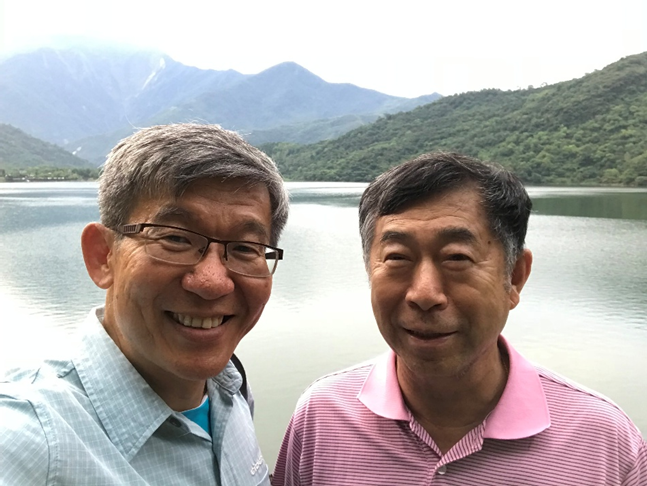

《兩代人的地景之路》- 王鑫教授(1945–2023)與李光中教授
“A Landscape Journey Across Generations” – Professors Wang Hsin (1945–2023) and Kuang-Chung Lee
The Landscape Conservation and Community Participation Laboratory is rooted in Taiwan’s long-standing tradition of exploring human–environment relationships and is profoundly shaped by the pioneering work of Professor Hsin Wang. His contributions expanded landscape conservation from the preservation of natural landforms to cultural landscapes, community participation, and collaborative governance, emphasizing the principle of “think globally, act locally.” These ideas have significantly influenced Professor Kuang-Chung Lee and continue to guide the evolution and innovation of the Laboratory.
The Lab’s intellectual origins trace back to Professor Lee’s doctoral research at University College London (1997–2001), where he critically examined Taiwan’s conservation practice and recognized that sustainable conservation requires community support, dialogue, and shared decision-making rather than one-way education. After returning to Taiwan, he established the Laboratory in 2008, grounding it in cultural landscape theory, qualitative social science, and a framework connecting global thinking, national application, and local action – “think global, adapt national, act local”.
The Lab has since adapted international frameworks—such as UNESCO cultural landscapes, Global Geoparks, IUCN categories of protected areas, and the Satoyama Initiative—into collaborative, place-based applications in Taiwan. Through participatory action research, social-ecological resilience assessments, multi-stakeholder platforms, and community capacity-building, the Lab works closely with the Indigenous Peoples and local communities (IPLC) in mountainous and coastal villages of eastern rural Taiwan on promotion of integrated landscape and seascape approaches (ILSA).
In 2024, building on this foundation, Professor Lee and Dr. Paulina G. Karim (formerly his doctoral student) established the @ScapesLab Living Lab under the Center for Sustainable Development at National Dong Hwa University. The name – @ScapesLab – reflects the idea of diverse and dynamic ‘scapes’—a living laboratory for evolving landscape and seascape systems. Professor Lee serves as Director, and Paulina as CEO, expanding the Lab’s capacity to integrate research, teaching, community engagement, and international collaboration.
Since 2002, the Laboratory has nurtured 50 master’s and four doctoral graduates who now contribute to conservation, cultural heritage, environmental governance, and community development across Taiwan and beyond. Since February 2024, Paulina has continued Professor Lee’s academic legacy and has co-taught courses with him as an adjunct assistant professor at National Dong Hwa University, further strengthening the development of the @ScapesLab.
 國立東華大學永續發展中心里山里海辦公室