Fengnan Village, Fuli Township
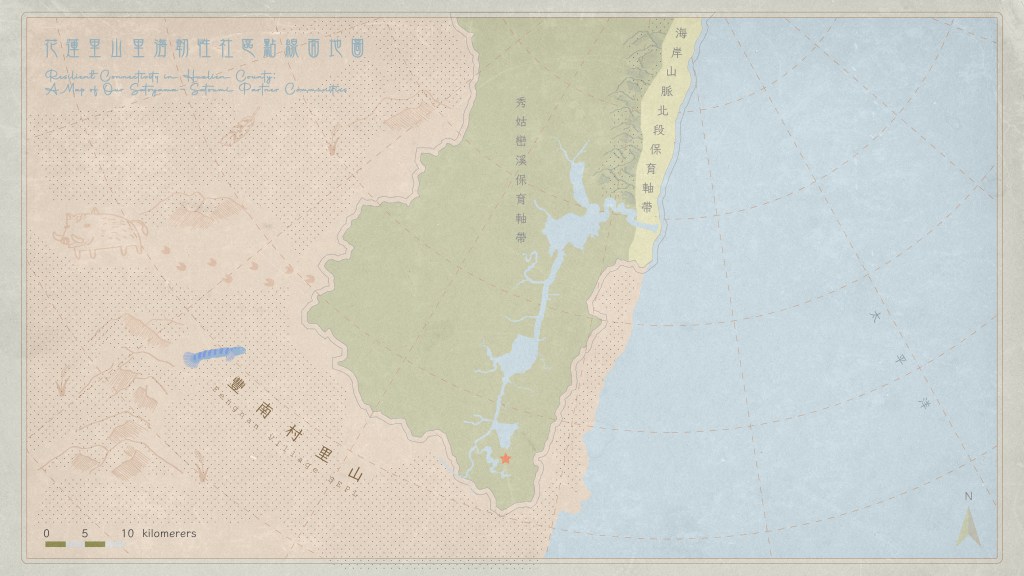
花蓮縣富里鄉豐南村社會─生態生產地景(SEPL)面積 3,289 公頃,位於秀姑巒溪最南端上游支流——鱉溪上游流域。這裡由阿美族、客家及閩南族群共同居住,其中阿美族佔六成以上,擁有狩獵、耕作、採集與野生植物利用等豐富的在地知識。依託其獨特的上游位置、多樣的地質地貌,以及百年來的人地互動傳統,豐南成為台灣地景整合取徑的先行示範。2011年成立的「Cihalaay 文化景觀」是國內最早的里山倡議實踐場域之一。社區長期推動友善耕作、串聯田區與溪流生態廊道、改善地景多樣性,以及協助處理人與野生動物衝突。社區與鱉溪特有洄游魚日本禿頭鯊(阿美語名為哈拉)的深厚連結,更催生了 2016 年獲獎的「哈拉米」品牌。近年來,透過「鱉溪地質公園籌備平台」與「物種保育與棲地復育平台」,豐南持續深化地質多樣性、河川生態保育與永續生計的合作,其成果亦促成 2022 年「鱉溪米」品牌的誕生,展現社區與河川地景和諧共生的願景。
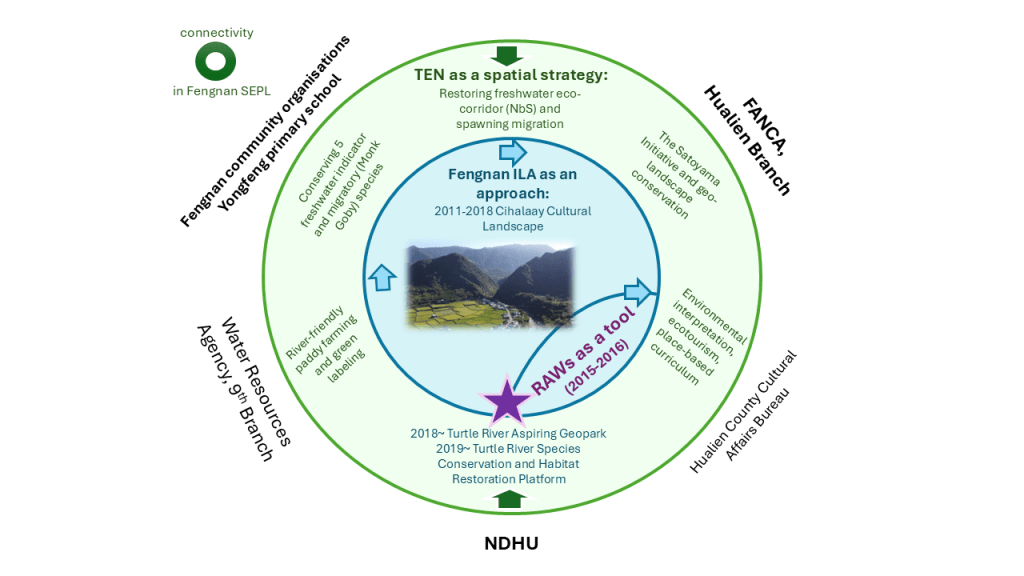
The Fengnan socio-ecological production landscape (SEPL) in Fuli Township, Hualien County, Taiwan, covers 3,289 ha. It lies in the uppermost reaches of the Turtle River, the southernmost tributary of eastern Taiwan’s Xiuguluan River. Fengnan SEPL is home to Amis, Hakka, and Hokkien communities, with Indigenous Amis people forming the majority and contributing rich knowledge of hunting, farming, foraging, and wild plants. Fengnan’s unique upstream location, diverse geology, and long history of nature–culture interactions have made it a leading example of integrated landscape approach in Taiwan. Since 2011, the Cihalaay Cultural Landscape has showcased early Satoyama Initiative practices and community-led conservation. Local efforts have strengthened eco-friendly rice farming, improved stream and farmland connectivity, and addressed human–wildlife conflicts. The community’s close relationship with the endemic monk goby (Hala) inspired the creation of the award-winning “Hala Rice” brand in 2016. In recent years, Fengnan has expanded its vision through the Turtle River Aspiring Geopark and the Turtle River Species Conservation and Habitat Restoration Platform, focusing on geodiversity, freshwater species conservation, and sustainable local livelihoods. These collaborations led to the launch of the “Turtle River Rice” brand in 2022, highlighting Fengnan’s ongoing commitment to living in harmony with its river landscape.

關於豐南 SEPL 的發表文章
Our Publications about Fengnan SEPL
- 邱雅莘、李光中* (2022) 當地方本位教育遇上企業慈善計畫-以花蓮縣豐南村Pakalongay解說員培訓課程為例。環境教育研究,17(2)。http://ee.gise.ntnu.edu.tw/jeer/pdf/JEER.2021.17.2.89.pdf
- 李光中、許子翊、江紹瑜、藍姆路 卡造、李柏賢(2015)我國文化景觀保存策略—以持續作用的文化景觀為例。文化資產保存學刊,34:66-92。https://ppt.cc/fFCtPx
- 李光中、張惠珠、王鑫、陳柏瑞、王鈴琪、蔡佩芳(2008)花蓮文化景觀調查的社區參與取徑初探。第二屆花蓮學研討會論文集。花蓮,97 年10 月25-26 日,花蓮縣文化局,第12~44 頁。
- Lee, K.C. & Karimova, P.G. (2021) “From cultural landscape to aspiring geopark: 15 years of community-based landscape tourism in Fengnan Village, Hualien County, Taiwan (2006-2021),” Geosciences, 11(8), 310; https://doi.org/10.3390/geosciences11080310
- Lee, K.C. & Yan, S.Y. (2019). “Participatory planning and monitoring of protected landscapes: a case study of an indigenous rice paddy cultural landscape in Taiwan,” Paddy and Water Environment, 17 (3), 539-548. https://doi.org/10.1007/s10333-019-00750-1
- Lee, K.C. (2019) “Weaving Traditional Ecological Knowledge into Indigenous Youth Education: A Case Study in an Indigenous Rice Paddy Cultural Landscape, Taiwan,” In: Culture and Environment: Weaving New Connections, pp.425-443, ISBN:978-90-04-39668-5, Brill, Leiden, Netherlands. https://doi.org/10.1163/9789004396685_025
- Lee, K.C., Kacaw, L., Chen, M.L., Shia, J.S. & Fan, M.L. (2016). “Tailoring the Satoyama Initiative concepts to the national and local context: a case study of the collaborative planning process of a rice paddy cultural landscape in an indigenous community, Taiwan,” In: Mainstreaming concepts and approaches of socio-ecological production landscapes and seascapes into policy and decision-making (Satoyama Initiative Thematic Review vol. 2), pp.50-58, ISBN:978-92-808-4573-0, United Nations University Institute for the Advanced Study of Sustainability (UNU-IAS), Tokyo, Japan. https://collections.unu.edu/eserv/UNU:5890/SITR_vol2_complete.pdf
 國立東華大學永續發展中心里山里海辦公室