Xinshe Village, Fengbin Township
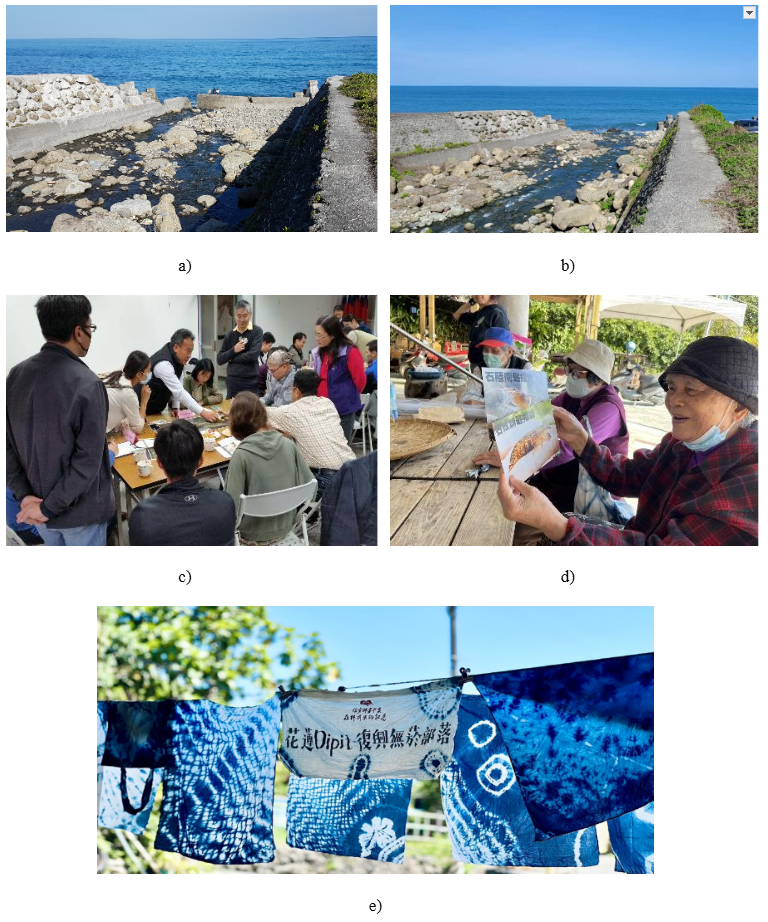
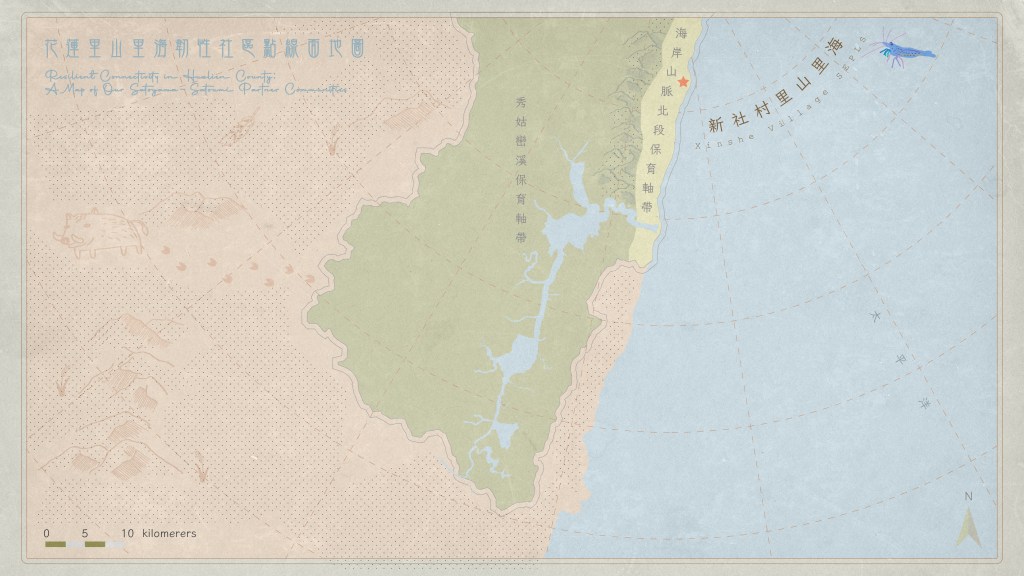
花蓮縣豐濱鄉新社村社會-生態生產地景與海景(SEPLS,600公頃)位於台灣海岸山脈北段保育軸帶上,面向太平洋,是典型的森-川-里-海連通地景與海景。新社SEPLS位於大不岸/加塱溪的流域中,是台灣東部海岸常見的獨立溪流生態系。此地為阿美族 Dipit 部落與噶瑪蘭族 pateRungan 部落的傳統領域。梯田水稻耕作、家庭菜園、原生作物栽種、編織、野菜採集、漁撈與潮間帶海藻採集等活動,展現了族人長久以來與土地、河川與海洋的密切連結。
新社「森-川-里-海生態農業倡議」(簡稱新社倡議)於 2016 年啟動(2016–2020 年短期、2021–2026 年中期),是台灣研究最完整、成熟度最高的地景海景整合取徑(ILSA)實例之一。其多元權益關係人平台由兩個部落、四個政府機關、新社國小、噶瑪蘭族語推廣協會及國立東華大學@ScapesLab團隊共同組成,並持續吸引其他單位參與。初期行動計畫借鏡豐南的 Cihalaay 文化景觀,並以里山倡議五大觀點作為設計基礎。
新社 ILSA 已兩度運用韌性評估工作坊(RAWs):2017–2018 年調整短期行動計畫、2020 年制定中期計畫。除了運用國際版的 SEPLS 韌性指標工具,也開發了台灣第一套在地化指標,並成為後續案例的範例。社區提出的關鍵議題包括:生物多樣性盤點、休耕地復育與友善耕作、森-川-里-海連通性、家庭用水與灌溉水質水量、遏止違法捕撈,以及強化海岸與海洋資源的永續利用。
大不岸/加塱溪為連結山林與太平洋的重要生態廊道。過去 1990 年代沿溪建置的 171 座攔砂壩阻斷了 21 種稀有溪蝦的洄游。透過多元權益關係人平台的跨部門協調(含花蓮縣府與生態顧問公司),2018–2020 年成功拆除下游九座攔砂壩,包括河口最大的一座。後續監測顯示蝦類數量大幅回升,重建了部落的自豪感,也成為新社國小的在地課程內容,象徵著重新恢復的地景-海景生態廊道。
如今,新社 SEPLS 已成為台灣社區主導的社會-生態韌性、生態復育、淡海連結與ILSA的典範,其經驗正持續引導全台其他地區的行動。

The Xinshe socio-ecological production landscape and seascape (SEPLS, 600 ha) is in Fengbin Township, Hualien County, Taiwan. It lies along the northern section of Taiwan’s Coastal Mountain Range conservation corridor, facing the vast Pacific Ocean. Here, forest, river, village, and ocean are closely linked, forming a classic ridge-to-reef landscape-seascape connectivity. Xinshe is situated in the watershed of the independent Dabuan/Jialang Stream—one of the typical short coastal streams of eastern Taiwan—and is home to the Indigenous Amis Dipit and Kavalan pateRungan tribes. Terraced paddy farming, home gardens, weaving traditions, fishing, wild plant and seaweed foraging all reflect deep, ongoing relationships between people and place.
Established in 2016, the Xinshe Forest-River-Village-Ocean Eco-Agriculture Initiative (the Xinshe Initiative) is Taiwan’s most documented and most mature integrated landscape and seascape approaches (ILSA). Its multi-stakeholder platform brings together local tribes, government agencies, Xinshe Primary School, Kavalan Language Promotion Association, and National Dong Hwa University @ScapesLab team. Early planning drew inspiration from Fengnan’s Cihalaay Cultural Landscape, adapting its lessons into the first action plan of the Xinshe Initiative.
Resilience assessment workshops (RAWs, 2017–2018 and 2020) have been central to identifying issues and guiding the adaptive co-management of the Xinshe SEPLS. Notably, Xinshe was also the place where Taiwan’s first localised set of resilience indicators was developed. Through these workshops, the community identified priority actions such as conducting biodiversity surveys, revitalising terraced paddies through eco-friendly farming, enhancing freshwater–marine connectivity, improving household and irrigation water security, preventing illegal fishing, and strengthening stewardship of river and ocean resources.
The Dabuan/Jialang Stream is the key ecological linkage between inland forests and the Pacific Ocean. Historically, 171 river weirs built in the 1990s blocked the migration of 21 rare shrimp species. Through cross-sector negotiation under the Xinshe Initiative, nine downstream weirs were removed between 2018–2020—including the largest one at the river mouth. Ecological monitoring now shows a strong return of local shrimp varieties, rekindling community pride and inspiring youth. Shrimp have even become part of the place-based curriculum at Xinshe Primary School—a symbol of restored ecological corridors.
Today, Xinshe SEPLS stands as a national model for community-led ecosystem restoration, freshwater–marine connectivity, and integrated landscape–seascape governance. Its experience continues to guide similar ILSA efforts across Taiwan.
關於新社 SEPLS 的發表文章
Our Publications about Xinshe SEPLS
- 孫夏天、李光中(2024)透過里山倡議地景與海景整體取徑實現2050人與自然和諧共生之願景。國際開發援助現場季刊,18, 10-23。https://reurl.cc/V0vjz5
- 孫夏天、顏佋伃、李光中(2020)營造韌性的「森-川-里-海」:韌性指標在地化並融入花蓮新社村「社會-生態-生產地景與海景」的調適經營。臺灣林業,46(6): 59-80。https://www.forest.gov.tw/MagazineFile.aspx?fno=6873
- 李光中、徐仲禹、許芳嘉、張志豪、宮莉筠、張慧芬(2017)花蓮新社村:森-川-里-海 生態農業倡議。大自然,136, 82-87。https://issuu.com/swan.thenature/docs/136______s/6
- Karim, P.G. and Lee, K.C. (2025) Future-scaping: lessons learned from co-visioning a resilient future within an integrated landscape and seascape approach (ILSA) in eastern coastal Taiwan. Frontiers in Sustainable Food Systems. 9:1685945. https://doi.org/10.3389/fsufs.2025.1685945
- Karim, P.G. and Lee, K.C. (2024). Landscape Approaches for the 30×30 Target: Potential Applications and Practical Recommendations. PARKS 30(2), 78-84; https://parksjournal.com/wp-content/uploads/2024/12/Karim-and-Lee_Short-communication_PARKS-30.2.pdf
- Karimova, P.G. and Lee, K.C.* (2023). The Many Meanings of ‘One’: The Concept and Practice of the One Health Approach in Socio-Ecological Production Landscapes and Seascapes. CABI One Health, 2, 1; https://www.cabidigitallibrary.org/doi/10.1079/cabionehealth.2023.0026
- Karimova, P.G. and Lee, K.C.* (2022). An Integrated Landscape–Seascape Approach in the Making: Facilitating Multi-Stakeholder Partnership for Socio-Ecological Revitalisation in Eastern Coastal Taiwan (2016–2021). Sustainability 14(7), 4238; https://doi.org/10.3390/su14074238
- Karimova, P.G.; Yan, S.Y.; Lee, K.C.* (2022). SEPLS well-being as a vision: co-managing for diversity, connectivity and adaptive capacity in Xinshe Village, Hualien County, Taiwan. UNU-IAS and IGES (eds.) Nexus among biodiversity, health, and sustainable development in managing socio-ecological production landscapes and seascapes (SEPLS), Satoyama Initiative Thematic Review vol. 7, UNU-IAS, Tokyo, Springer Nature. https://link.springer.com/content/pdf/10.1007%2F978-981-16-9893-4_4
- Karimova, P.G. and Lee, K.C.* (2021). The Good, the Bad and the Adaptive: resilient local solutions to tourism related system shifts in Eastern rural Taiwan. Nottingham University, Taiwan Insight (online publication). https://taiwaninsight.org/2021/07/31/the-good-the-bad-and-the-adaptive-resilient-local-solutions-to-tourism-related-system-shifts-in-eastern-rural-taiwan/
- Lee, K.C.; Karimova, P.G.; Yan, S.Y. & Li Y.S. (2020). Resilience assessment workshops: a biocultural approach to conservation management of a rural landscape in Taiwan. Sustainability 12, 408. https://doi.org/10.3390/su12010408
- Lee, K.C.; Karimova, P.G.; Yan, S.Y. (2019). Towards an integrated multi-stakeholder landscape approach to reconciling values and enhancing synergies: a case study in Taiwan. UNU-IAS and IGES (eds.) Understanding the multiple values associated with sustainable use in socio-ecological production landscapes and seascapes (SEPLS), Satoyama Initiative Thematic Review vol. 5, UNU-IAS, Tokyo. https://collections.unu.edu/eserv/UNU:7506/SITR_vol5_fullset_web.pdf
 國立東華大學永續發展中心里山里海辦公室